Probability Frameworks Shaping Blackjack Tactics and Soccer Forecasts in Regulated British Markets
Written by Quinn Schmidt · Aug 20, 2026

Probability Frameworks Shaping Blackjack Tactics and Soccer Forecasts in Regulated British Markets
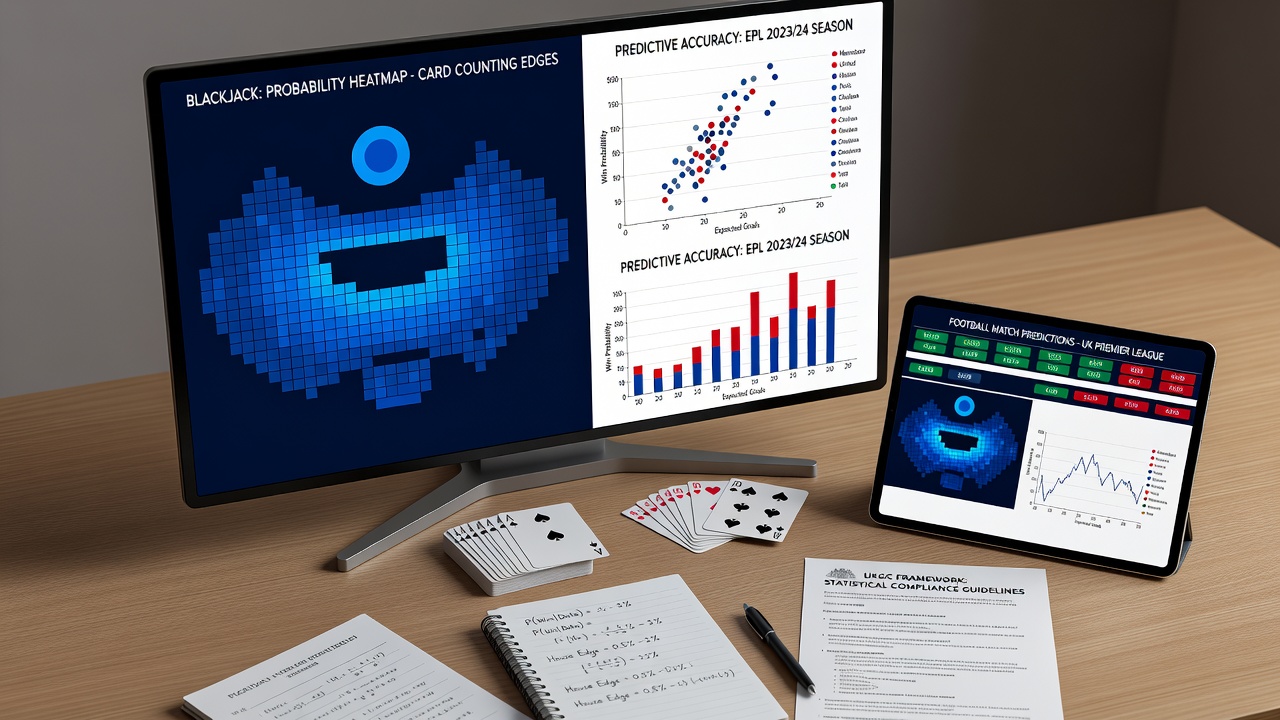
Statistical analysis forms the core of many approaches to blackjack and football match predictions within UK gambling frameworks, where operators must align strategies with probability models and regulatory standards. Researchers have long examined how card counting systems in blackjack rely on tracking remaining high and low cards to shift the house edge, while Poisson distributions and regression models help forecast football outcomes based on historical team data and player performance metrics. These methods intersect with British licensing rules that require transparency in game fairness and betting odds calculations.
Core Statistical Elements in Blackjack
Basic strategy charts in blackjack derive from exhaustive computations of every possible hand combination against dealer upcards, producing decisions that minimize expected loss over thousands of plays. Data from simulation studies shows that following these charts reduces the house advantage to around 0.5 percent in standard multi-deck games with favorable rules. Card counting builds on this foundation by assigning values to cards, typically plus one for low cards and minus one for high cards, allowing players to adjust bets when the remaining deck favors the player. Observers note that systems like the Hi-Lo count require precise running count conversion to true count by dividing by decks left, a step that demands constant recalibration during play.
Additional layers appear in advanced techniques such as shuffle tracking and ace sequencing, though these demand even greater computational tracking and remain subject to casino countermeasures like frequent reshuffles. Studies from academic sources indicate that variance in blackjack outcomes follows a normal distribution over large sample sizes, meaning short-term swings can exceed calculated edges before longer runs reveal the underlying mathematics.
Modeling Football Match Predictions
Football predictions within the same UK frameworks draw heavily on expected goals models that estimate scoring rates from shot location, type, and quality rather than final scores alone. Analysts apply bivariate Poisson distributions to account for both teams scoring simultaneously, incorporating variables like home advantage, recent form, and head-to-head records. Figures from industry reports reveal that these models achieve improved accuracy over simple win-draw-loss percentages when calibrated against multiple seasons of Premier League data. Machine learning extensions add player tracking metrics and weather factors, refining probability outputs for betting markets such as over/under totals and Asian handicaps.
One study revealed that incorporating in-game variables like possession and pass completion rates further tightens prediction intervals, though random elements such as referee decisions and injuries introduce irreducible uncertainty. Those who've studied this know that calibration against actual results remains essential, as unadjusted models tend to overestimate favorites and underestimate draws.
Integration Within UK Regulatory Structures
British operators must demonstrate that advertised odds reflect underlying probabilities derived from these statistical methods, a requirement enforced through testing by independent laboratories. In August 2026, updates to remote gambling standards emphasized real-time monitoring of game outcomes against expected statistical distributions to detect anomalies. This aligns with broader European approaches, including oversight from bodies like the Malta Gaming Authority and research from institutions such as the University of Nevada's gaming studies program, which have published comparative analyses of probability disclosure rules across jurisdictions.
Take one researcher who examined cross-market data and found that football prediction services often publish confidence intervals alongside point estimates, allowing bettors to gauge model reliability. Blackjack side bets, by contrast, carry higher house edges that remain fixed regardless of card counting, a fact highlighted in regulatory guidelines to protect consumers. External verification through organizations like the American Gaming Association further supports transparency in how operators calculate and display return-to-player percentages.
Challenges and Practical Applications
Combining blackjack and football analytics under one framework highlights shared reliance on large datasets and computational power, yet each faces distinct practical hurdles. Blackjack counters must contend with table limits and detection algorithms, while football modelers grapple with data noise from subjective officiating. Evidence suggests that hybrid approaches, such as using similar Bayesian updating techniques across both domains, can improve decision speed for professional operators and syndicates. What's interesting is how regulatory audits in multiple regions now require documentation of these models to ensure they do not mislead participants about long-term expected values.
Conclusion
Statistical foundations continue to underpin both blackjack strategies and football match predictions across UK gambling frameworks, supported by ongoing research and cross-jurisdictional standards. Probability models provide the measurable basis for game design, odds setting, and compliance verification, while data from diverse sources including academic studies and international regulators helps maintain consistency. Those who apply these methods consistently observe that success hinges on rigorous calibration and adherence to documented distributions rather than intuition alone.